Tutorial math and reading software for elementary and secondary arithmetic, basic math, algebra, geometry, precalculus plus GED, ABE, and CLEP preparation for elementary school, high school, college, adult education, and homeschool students.
What Does Real Encouragement Look Like?
Product Description
Many people equate encouragement with praise (“Good job!” “You’re so smart!”) and positivity.
But true encouragement is broader and deeper:
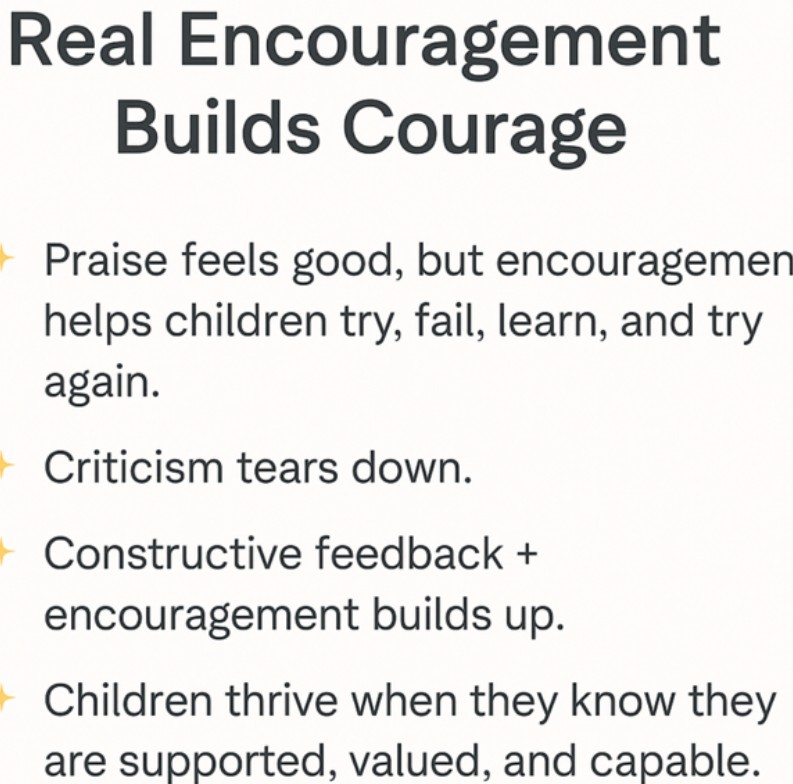
✅ It supports growth without inflating ego.
✅ It builds courage to try, fail, and try again.
✅ It can include constructive feedback—but only when delivered in a safe, supportive way.
Criticism that is harsh, personal, or constant shuts students and children down.
Constructive, caring feedback with encouragement can build skills and resilience.
Criticism tears down.
Constructive feedback + encouragement builds up.
1️⃣ What is encouragement, really?
More than compliments. It is supporting a child’s efforts, progress, and courage to keep trying.
2️⃣ Why empty praise falls short:
Praise like “You’re so smart” may lead to fear of failure. Children may become praise-dependent.
3️⃣ The role of feedback:
Criticism = negative, personal attack (“You’re so careless!”). Feedback = specific, non-judgmental, actionable (“You missed this step. Let’s go back and try together.”).
4️⃣ How to encourage effectively:
Notice effort: “I see how hard you worked on this.” Highlight progress: “Last month, this was tough, and now you’re getting it.” Show faith: “I know you can figure this out. Let’s take it step by step.” Stay calm when correcting mistakes.
5️⃣ Encouragement builds independence:
Encouraged children try new things, take risks, and recover from setbacks. Encouragement creates a safe space to grow.
Encouragement Isn’t Just Praise
As parents and teachers, we all want to encourage the children in our care. But what does real encouragement look like?
Many people think encouragement is simply praise:
“Good job!” “You’re so smart!” “You’re amazing!”
While praise feels good in the moment, it doesn’t always build the long-term courage and resilience children need. Real encouragement goes deeper. It isn’t about shielding children from mistakes or pumping up their egos. It’s about helping them feel safe to try, fail, learn, and try again.
What’s the difference between encouragement and criticism?
Criticism tears down. It labels, judges, and often attacks the person: “You’re so careless.” “You never get this right.” “What’s wrong with you?”
Children (and adults) shut down under constant criticism, becoming fearful of making mistakes.
What about feedback? Isn’t that criticism?
Feedback is different:
✅ It’s specific, actionable, and non-judgmental. ✅ It focuses on the work, not the person. ✅ It invites growth. “You missed a step here—let’s look at it together.” “Your paragraph is strong, and we can make it even clearer by adding this example.”
When feedback is paired with encouragement, it becomes a tool for learning, not a weapon for shame.
What does real encouragement sound like?
✅ Noticing effort: “I see how hard you worked on this.” ✅ Highlighting progress: “This was tough for you last month and now you’re getting it.” ✅ Showing faith: “I know you can figure this out, one step at a time.” ✅ Staying calm: Mistakes are learning moments, not disasters.
Why this matters:
Children encouraged in this way:
Feel safe to take healthy risks. Build independence and problem-solving skills. Learn to bounce back from setbacks. Understand that effort and growth matter more than instant perfection.
Encouragement is not about protecting children from mistakes or only giving praise. It’s about giving them the courage to try, fail, learn, and try again—knowing they are supported, valued, and capable. Let’s build environments where our encouragement helps children grow into confident lifelong learners.
But true encouragement is broader and deeper:
✅ It supports growth without inflating ego.
✅ It builds courage to try, fail, and try again.
✅ It can include constructive feedback—but only when delivered in a safe, supportive way.
Criticism that is harsh, personal, or constant shuts students and children down.
Constructive, caring feedback with encouragement can build skills and resilience.
Criticism tears down.
Constructive feedback + encouragement builds up.
1️⃣ What is encouragement, really?
More than compliments. It is supporting a child’s efforts, progress, and courage to keep trying.
2️⃣ Why empty praise falls short:
Praise like “You’re so smart” may lead to fear of failure. Children may become praise-dependent.
3️⃣ The role of feedback:
Criticism = negative, personal attack (“You’re so careless!”). Feedback = specific, non-judgmental, actionable (“You missed this step. Let’s go back and try together.”).
4️⃣ How to encourage effectively:
Notice effort: “I see how hard you worked on this.” Highlight progress: “Last month, this was tough, and now you’re getting it.” Show faith: “I know you can figure this out. Let’s take it step by step.” Stay calm when correcting mistakes.
5️⃣ Encouragement builds independence:
Encouraged children try new things, take risks, and recover from setbacks. Encouragement creates a safe space to grow.
Encouragement Isn’t Just Praise
As parents and teachers, we all want to encourage the children in our care. But what does real encouragement look like?
Many people think encouragement is simply praise:
“Good job!” “You’re so smart!” “You’re amazing!”
While praise feels good in the moment, it doesn’t always build the long-term courage and resilience children need. Real encouragement goes deeper. It isn’t about shielding children from mistakes or pumping up their egos. It’s about helping them feel safe to try, fail, learn, and try again.
What’s the difference between encouragement and criticism?
Criticism tears down. It labels, judges, and often attacks the person: “You’re so careless.” “You never get this right.” “What’s wrong with you?”
Children (and adults) shut down under constant criticism, becoming fearful of making mistakes.
What about feedback? Isn’t that criticism?
Feedback is different:
✅ It’s specific, actionable, and non-judgmental. ✅ It focuses on the work, not the person. ✅ It invites growth. “You missed a step here—let’s look at it together.” “Your paragraph is strong, and we can make it even clearer by adding this example.”
When feedback is paired with encouragement, it becomes a tool for learning, not a weapon for shame.
What does real encouragement sound like?
✅ Noticing effort: “I see how hard you worked on this.” ✅ Highlighting progress: “This was tough for you last month and now you’re getting it.” ✅ Showing faith: “I know you can figure this out, one step at a time.” ✅ Staying calm: Mistakes are learning moments, not disasters.
Why this matters:
Children encouraged in this way:
Feel safe to take healthy risks. Build independence and problem-solving skills. Learn to bounce back from setbacks. Understand that effort and growth matter more than instant perfection.
Encouragement is not about protecting children from mistakes or only giving praise. It’s about giving them the courage to try, fail, learn, and try again—knowing they are supported, valued, and capable. Let’s build environments where our encouragement helps children grow into confident lifelong learners.
- Educational Comments & Articles
- Schools and Institutions - Licenses
- MathMedia Education Bundles
- Arithmetic
- Basic Math Software Series - Fractions
Decimals
Percents
PreAlgebra
Geometry - ABE - Math
- Reading Comprehension-Critical Thinking Series with Phonics, Grammar, & Values
- Algebra by Chapter (Set of eight programs)
- Algebra by Topic
- Geometry
- Advanced Mathematics
- GED®Test Prep Bundle
- GED - Beginning Practice Math Test
- PSAT / SAT - Math
- College Level - CLEP Test Prep
- HOME USERS
- System Requirements
- Satisfied Customers
- Why Choose MathMedia?
- How to Use MathMedia - FAQ
- Article Archives
- ORDER FORM



