Tutorial math and reading software for elementary and secondary arithmetic, basic math, algebra, geometry, precalculus plus GED, ABE, and CLEP preparation for elementary school, high school, college, adult education, and homeschool students.
Is It Better to Go to a 2-Year College or a 4-Year College? Calm, clear guidance on pros, cons, and considerations.
Product Description
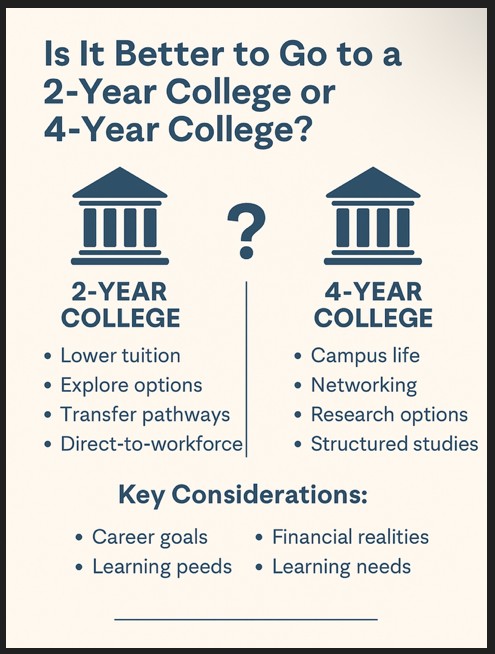
✨ Many students and parents feel pressure to choose 4-year colleges automatically, without considering financial realities or career goals. Acknowledge emotions tied to “college prestige.”
✨ Rising student debt makes 2-year colleges (community colleges) an increasingly wise path for many.
✨ Decisions: Financial costs, career paths, family pressure, societal expectations. Readers need calm, clear guidance on pros, cons, and considerations.
The Case for 2-Year Colleges
✅ Lower tuition, lower debt
✅ Flexibility for undecided students
✅ Direct-to-workforce options (certifications, trades)
✅ Ability to transfer to a 4-year college later
✅ Smaller class sizes, more support students
The Case for 4-Year Colleges
✅ Direct access to bachelor’s degrees
✅ Broader campus life and networking opportunities
✅ Often necessary for certain careers (medicine, law, engineering)
✅ Research and advanced learning opportunities
Key Questions to Consider
✅ What career goals does the student have?
✅ Is the chosen field one where certifications/associates suffice?
✅ How important are campus experiences and networking?
✅ What can the family realistically afford without crushing debt?
Real-World Examples
✅ A student who went to community college, then transferred to a top university with zero debt.
✅ A student who went directly to a 4-year college, found clear direction, and leveraged opportunities.
✅ A cautionary example of taking on too much debt without a clear return.
Conclusion:
There is no one-size-fits-all answer. Encourages thoughtful planning, using numbers, and matching decisions to individual goals and family circumstances. Emphasizes that college is not about prestige but about positioning yourself for a fulfilling, financially sustainable future.
✅Action to take:
“If you’re deciding between a 2-year and 4-year path, sit down with your family and list your goals, interests, and the true costs. Education is an investment, and the right path is the one that aligns with your future, not someone else’s expectations.”
More discussion to factor into decisions:
Is It Better to Go to a 2-Year College or a 4-Year College?
For many families, the path after high school feels automatic: go straight to a 4-year college, get a degree, and move into a career. But with rising tuition costs, student debt concerns, and rapidly changing job markets, it’s worth asking:
Is a 4-year college always the best next step? Or could starting at a 2-year community college be the smarter move?
The Case for 2-Year Colleges
Community colleges offer lower tuition, smaller class sizes, and flexibility—benefits that matter deeply for students unsure of their future path or families watching budgets closely.
✅ Lower Cost, Lower Debt: The average cost of community college is a fraction of a 4-year college, allowing students to take general education requirements at a much lower price.
✅ Flexible for Undecided Students: Many students aren’t sure what they want to study at age 18. Community college offers breathing room to explore courses without the financial pressure of high tuition.
✅ Direct-to-Workforce Options: Community colleges often offer certification programs and associate degrees in practical fields like healthcare, technology, or skilled trades, providing pathways to good-paying jobs without a four-year commitment.
✅ Transfer Pathways: Students can complete two years, then transfer to a 4-year college to finish a bachelor’s degree, entering as juniors. Many states have articulation agreements to make this process seamless.
✅ Supportive Learning Environment: Smaller class sizes and more individualized attention can be ideal for students who need academic support before tackling the rigor of a university.
The Case for 4-Year Colleges
While the 2-year college route offers many advantages, 4-year colleges still provide important opportunities:
✅ Direct Bachelor’s Degree Completion: For fields requiring a bachelor’s or higher degree (engineering, law, medicine, education), starting at a 4-year college may simplify the path.
✅ Broader Campus Life and Networking: Living on campus, participating in clubs, and building lifelong connections are hallmarks of many 4-year college experiences.
✅ Research and Advanced Learning: Universities often offer specialized courses, research opportunities, and mentorship connections that can shape a student’s academic direction.
✅ Structured Academic Environment: Some students thrive in the consistent academic and social environment of a 4-year college.
Key Questions to Consider
Before deciding, it helps to reflect on:
✅ Career Goals: What field does the student want to enter, and what level of education is required? Many jobs do not require a bachelor’s degree, while others do.
✅ Financial Realities: What can your family truly afford without crushing debt? Have you calculated the total cost (tuition, housing, transportation, fees)?
✅ Learning Needs: Does the student need more time to mature academically or socially before a university setting?
✅ Personal Preferences: Is the social environment of a 4-year college a priority? Would living at home for a couple of years help the student adjust better?
Real-World Examples
✨ Maria’s Story: Maria wasn’t sure what she wanted to major in, so she enrolled in a community college, discovered a passion for graphic design, and transferred to a university to complete her degree, graduating debt-free.
✨ Jacob’s Story: Jacob knew he wanted to be a civil engineer, so he chose a 4-year college with a strong engineering program, allowing him to connect with professors and internship opportunities early.
✨ A Cautionary Tale: A student took on heavy student loans to attend a private 4-year college without a clear career plan, struggled to finish, and now faces loan payments without a corresponding income.
Conclusion: No One-Size-Fits-All Answer (The college experience.)
Choosing between a 2-year and 4-year college is not about prestige; it’s about strategy. The right choice depends on your goals, interests, financial realities, and desired lifestyle.
Whether you choose a community college first or head straight to a 4-year college, what matters most is aligning your education with your life goals while being mindful of debt and employability.
Take Action:
Sit down as a family and:
✅ Write down career interests and educational requirements.
✅ Research local community college programs and 4-year options.
✅ Calculate the real costs, including living expenses and debt.
✅ Consider the student’s readiness and learning preferences.
Education is an investment in the future. Choosing the path that aligns with your goals, values, and financial health can set the stage for a fulfilling, sustainable future—without regret.
How Math and Reading Proficiency Tie Into Choosing 2-Year vs. 4-Year College
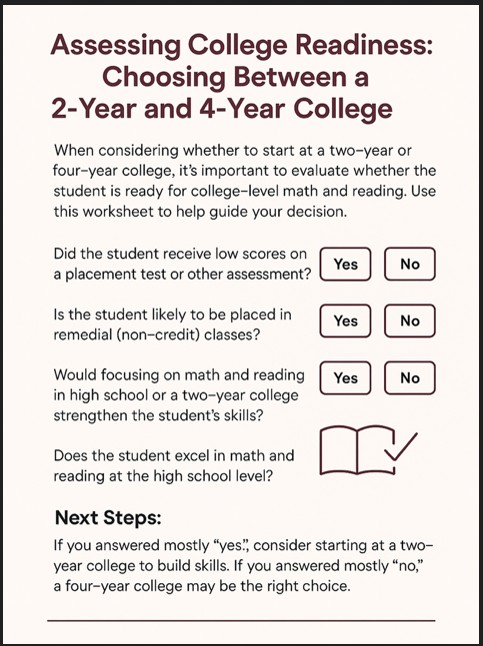
A factor often overlooked in deciding between a 2-year and 4-year college is the student’s current math and reading proficiency. These foundational skills directly impact success in any post-secondary program and should guide your decision-making. Four year colleges usually test math proficiency for placement into the courses that match student abilities.
✅ Why It Matters:
✨ College-level coursework assumes strong reading comprehension and math reasoning skills.
✨ Students who struggle in these areas may face placement into remedial (non-credit) courses in college, costing money without earning progress toward a degree.
✨ This can lead to frustration, wasted resources, and even dropout if not addressed first.
✅ How Community Colleges Help:
✨ 2-year colleges can provide a softer landing for students who need to strengthen these skills before taking on the rigor of a 4-year program.
✨ Smaller class sizes and support services help students catch up while keeping costs low.
✨ Students can complete remedial work, then transition to credit classes without heavy debt.
✅ If the Student is Proficient:
Students who are already strong in math and reading may thrive in a 4-year setting, taking full advantage of academic opportunities and progressing efficiently toward their degree.
✅ Questions for Families
✨ Has the student taken a recent assessment or practice placement test to confirm readiness for college-level math and reading?
✨ Would an extra semester focusing on strengthening these skills save time and money later?
✨ Could dual enrollment at a community college during high school help build these skills while earning credits?
✅ Bottom Line:
✨ Math and reading proficiency are critical to making the 2-year vs. 4-year college decision wisely otherwise costs for taking remedial classes without college credit is a big waste of $$$!!!
✨ Starting at a community college can protect financial resources while strengthening these core skills, ensuring students are ready to succeed if they later transfer to a 4-year college.
✨ Rising student debt makes 2-year colleges (community colleges) an increasingly wise path for many.
✨ Decisions: Financial costs, career paths, family pressure, societal expectations. Readers need calm, clear guidance on pros, cons, and considerations.
The Case for 2-Year Colleges
✅ Lower tuition, lower debt
✅ Flexibility for undecided students
✅ Direct-to-workforce options (certifications, trades)
✅ Ability to transfer to a 4-year college later
✅ Smaller class sizes, more support students
The Case for 4-Year Colleges
✅ Direct access to bachelor’s degrees
✅ Broader campus life and networking opportunities
✅ Often necessary for certain careers (medicine, law, engineering)
✅ Research and advanced learning opportunities
Key Questions to Consider
✅ What career goals does the student have?
✅ Is the chosen field one where certifications/associates suffice?
✅ How important are campus experiences and networking?
✅ What can the family realistically afford without crushing debt?
Real-World Examples
✅ A student who went to community college, then transferred to a top university with zero debt.
✅ A student who went directly to a 4-year college, found clear direction, and leveraged opportunities.
✅ A cautionary example of taking on too much debt without a clear return.
Conclusion:
There is no one-size-fits-all answer. Encourages thoughtful planning, using numbers, and matching decisions to individual goals and family circumstances. Emphasizes that college is not about prestige but about positioning yourself for a fulfilling, financially sustainable future.
✅Action to take:
“If you’re deciding between a 2-year and 4-year path, sit down with your family and list your goals, interests, and the true costs. Education is an investment, and the right path is the one that aligns with your future, not someone else’s expectations.”
More discussion to factor into decisions:
Is It Better to Go to a 2-Year College or a 4-Year College?
For many families, the path after high school feels automatic: go straight to a 4-year college, get a degree, and move into a career. But with rising tuition costs, student debt concerns, and rapidly changing job markets, it’s worth asking:
Is a 4-year college always the best next step? Or could starting at a 2-year community college be the smarter move?
The Case for 2-Year Colleges
Community colleges offer lower tuition, smaller class sizes, and flexibility—benefits that matter deeply for students unsure of their future path or families watching budgets closely.
✅ Lower Cost, Lower Debt: The average cost of community college is a fraction of a 4-year college, allowing students to take general education requirements at a much lower price.
✅ Flexible for Undecided Students: Many students aren’t sure what they want to study at age 18. Community college offers breathing room to explore courses without the financial pressure of high tuition.
✅ Direct-to-Workforce Options: Community colleges often offer certification programs and associate degrees in practical fields like healthcare, technology, or skilled trades, providing pathways to good-paying jobs without a four-year commitment.
✅ Transfer Pathways: Students can complete two years, then transfer to a 4-year college to finish a bachelor’s degree, entering as juniors. Many states have articulation agreements to make this process seamless.
✅ Supportive Learning Environment: Smaller class sizes and more individualized attention can be ideal for students who need academic support before tackling the rigor of a university.
The Case for 4-Year Colleges
While the 2-year college route offers many advantages, 4-year colleges still provide important opportunities:
✅ Direct Bachelor’s Degree Completion: For fields requiring a bachelor’s or higher degree (engineering, law, medicine, education), starting at a 4-year college may simplify the path.
✅ Broader Campus Life and Networking: Living on campus, participating in clubs, and building lifelong connections are hallmarks of many 4-year college experiences.
✅ Research and Advanced Learning: Universities often offer specialized courses, research opportunities, and mentorship connections that can shape a student’s academic direction.
✅ Structured Academic Environment: Some students thrive in the consistent academic and social environment of a 4-year college.
Key Questions to Consider
Before deciding, it helps to reflect on:
✅ Career Goals: What field does the student want to enter, and what level of education is required? Many jobs do not require a bachelor’s degree, while others do.
✅ Financial Realities: What can your family truly afford without crushing debt? Have you calculated the total cost (tuition, housing, transportation, fees)?
✅ Learning Needs: Does the student need more time to mature academically or socially before a university setting?
✅ Personal Preferences: Is the social environment of a 4-year college a priority? Would living at home for a couple of years help the student adjust better?
Real-World Examples
✨ Maria’s Story: Maria wasn’t sure what she wanted to major in, so she enrolled in a community college, discovered a passion for graphic design, and transferred to a university to complete her degree, graduating debt-free.
✨ Jacob’s Story: Jacob knew he wanted to be a civil engineer, so he chose a 4-year college with a strong engineering program, allowing him to connect with professors and internship opportunities early.
✨ A Cautionary Tale: A student took on heavy student loans to attend a private 4-year college without a clear career plan, struggled to finish, and now faces loan payments without a corresponding income.
Conclusion: No One-Size-Fits-All Answer (The college experience.)
Choosing between a 2-year and 4-year college is not about prestige; it’s about strategy. The right choice depends on your goals, interests, financial realities, and desired lifestyle.
Whether you choose a community college first or head straight to a 4-year college, what matters most is aligning your education with your life goals while being mindful of debt and employability.
Take Action:
Sit down as a family and:
✅ Write down career interests and educational requirements.
✅ Research local community college programs and 4-year options.
✅ Calculate the real costs, including living expenses and debt.
✅ Consider the student’s readiness and learning preferences.
Education is an investment in the future. Choosing the path that aligns with your goals, values, and financial health can set the stage for a fulfilling, sustainable future—without regret.
How Math and Reading Proficiency Tie Into Choosing 2-Year vs. 4-Year College
A factor often overlooked in deciding between a 2-year and 4-year college is the student’s current math and reading proficiency. These foundational skills directly impact success in any post-secondary program and should guide your decision-making. Four year colleges usually test math proficiency for placement into the courses that match student abilities.
✅ Why It Matters:
✨ College-level coursework assumes strong reading comprehension and math reasoning skills.
✨ Students who struggle in these areas may face placement into remedial (non-credit) courses in college, costing money without earning progress toward a degree.
✨ This can lead to frustration, wasted resources, and even dropout if not addressed first.
✅ How Community Colleges Help:
✨ 2-year colleges can provide a softer landing for students who need to strengthen these skills before taking on the rigor of a 4-year program.
✨ Smaller class sizes and support services help students catch up while keeping costs low.
✨ Students can complete remedial work, then transition to credit classes without heavy debt.
✅ If the Student is Proficient:
Students who are already strong in math and reading may thrive in a 4-year setting, taking full advantage of academic opportunities and progressing efficiently toward their degree.
✅ Questions for Families
✨ Has the student taken a recent assessment or practice placement test to confirm readiness for college-level math and reading?
✨ Would an extra semester focusing on strengthening these skills save time and money later?
✨ Could dual enrollment at a community college during high school help build these skills while earning credits?
✅ Bottom Line:
✨ Math and reading proficiency are critical to making the 2-year vs. 4-year college decision wisely otherwise costs for taking remedial classes without college credit is a big waste of $$$!!!
✨ Starting at a community college can protect financial resources while strengthening these core skills, ensuring students are ready to succeed if they later transfer to a 4-year college.
- Educational Comments & Articles
- Schools and Institutions - Licenses
- MathMedia Education Bundles
- Arithmetic
- Basic Math Software Series - Fractions
Decimals
Percents
PreAlgebra
Geometry - ABE - Math
- Reading Comprehension-Critical Thinking Series with Phonics, Grammar, & Values
- Algebra by Chapter (Set of eight programs)
- Algebra by Topic
- Geometry
- Advanced Mathematics
- GED®Test Prep Bundle
- GED - Beginning Practice Math Test
- PSAT / SAT - Math
- College Level - CLEP Test Prep
- HOME USERS
- System Requirements
- Satisfied Customers
- Why Choose MathMedia?
- How to Use MathMedia - FAQ
- Article Archives
- ORDER FORM



