Tutorial math and reading software for elementary and secondary arithmetic, basic math, algebra, geometry, precalculus plus GED, ABE, and CLEP preparation for elementary school, high school, college, adult education, and homeschool students.
Information Alone Isn’t Enough
Product Description
Context Is Everything: Turning Information Into Understanding
These articles offer an educational voice to support learning in all its forms.
We live in an age of information overload. Facts, headlines, and tips fly at us constantly—yet, despite all this information, many students struggle to learn, adults struggle to make decisions, and confusion often reigns.
Why?
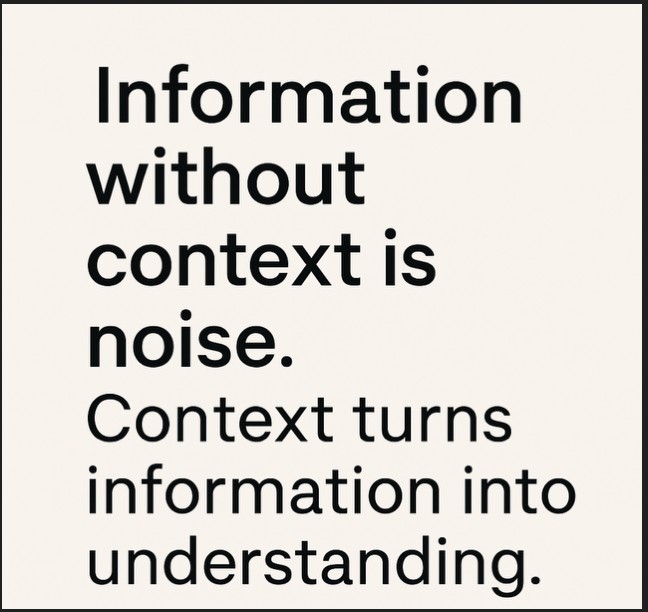
Because information without context is just noise. Context turns information into understanding. Context makes information relevant.
What is Context?
Context is the background, connections, and real-life applications that give information meaning.
It’s the difference between:
Memorizing a formula and understanding when to use it. Knowing a historical date and grasping why that event mattered. Hearing a health tip and knowing whether it applies to your situation. The ability to see where a piece of information fits in the bigger picture.
Examples of Context in Learning:
✅ Math:
Information only: “The area of a rectangle is length × width.” With context: “You want to buy a rug for your room. Measuring the length and width helps you find the right size. That’s why knowing how to calculate area is practical.” Math isn’t just about formulas. It’s about when to use them, why they matter, and how they connect to the world.
✅ Vocabulary:
Information only: “Define the word ‘ambiguous.’” With context: “We read a story where the ending was unclear. That’s what ‘ambiguous’ means—something open to more than one interpretation.” Vocabulary words are easier to remember when seen in a meaningful sentence, not in isolation.
✅ History:
Information only: “The Declaration of Independence was signed in 1776.” With context: “American colonists wanted to break free from British rule due to unfair taxation and lack of representation, leading them to sign the Declaration in 1776.” A history date means little without understanding the causes, people, and consequences surrounding it.
✅ Health:
Information only: “Vitamin D is important.” With context: “Vitamin D helps your bones stay strong by helping you absorb calcium. If you live in a place with little sunlight, you might need to get it from food or supplements.”
Why Context Matters:
1️⃣ Context makes information memorable.
We remember stories, connections, and real-world uses better than isolated facts.
2️⃣ Context empowers critical thinking.
Instead of blindly memorizing, learners can analyze when and how to use what they know.
3️⃣ Context helps us see patterns.
It turns “pieces of a puzzle” into a clear picture, making learning feel rewarding rather than frustrating.
Context in Everyday Decisions:
✅ You hear that the stock market dropped 2% today. Is that good or bad?
Without context, it’s just a scary number. With context, you learn it’s a minor dip after a year of growth, and it aligns with your long-term investment plan.
✅ You read that someone wakes up at 4:00 AM to work out and start their business. Should you do the same?
Without context, it feels like a rule for success. With context, you realize your lifestyle, health, and priorities may require a different schedule.
How Parents and Teachers Can Provide Context:
When helping children learn:
✅ Ask, “Where would we use this in real life?”
✅ Share stories about how you have used this information.
✅ Relate new lessons to something the child already knows.
For example:
“Remember when we baked cookies? We used fractions when measuring ingredients.” “When we drove to Grandma’s house, we used a map and distance. That’s why learning about miles is helpful.”
How Students Can Seek Context:
✅ Whenever you learn something new, ask:
“Why does this matter?” “Where would I use this?” “What does this connect to that I already know?”
✅ Use the Learning with Context Worksheet (linked below) to make this a habit.
Conclusion: Information Alone Isn’t Enough
We don’t need more random facts; we need understanding to navigate school, work, and life with confidence. Context transforms information into usable knowledge. Make it a habit to seek, provide, and teach in context—and watch learning and clarity blossom.
These articles offer an educational voice to support learning in all its forms.
We live in an age of information overload. Facts, headlines, and tips fly at us constantly—yet, despite all this information, many students struggle to learn, adults struggle to make decisions, and confusion often reigns.
Why?
Because information without context is just noise. Context turns information into understanding. Context makes information relevant.
What is Context?
Context is the background, connections, and real-life applications that give information meaning.
It’s the difference between:
Memorizing a formula and understanding when to use it. Knowing a historical date and grasping why that event mattered. Hearing a health tip and knowing whether it applies to your situation. The ability to see where a piece of information fits in the bigger picture.
Examples of Context in Learning:
✅ Math:
Information only: “The area of a rectangle is length × width.” With context: “You want to buy a rug for your room. Measuring the length and width helps you find the right size. That’s why knowing how to calculate area is practical.” Math isn’t just about formulas. It’s about when to use them, why they matter, and how they connect to the world.
✅ Vocabulary:
Information only: “Define the word ‘ambiguous.’” With context: “We read a story where the ending was unclear. That’s what ‘ambiguous’ means—something open to more than one interpretation.” Vocabulary words are easier to remember when seen in a meaningful sentence, not in isolation.
✅ History:
Information only: “The Declaration of Independence was signed in 1776.” With context: “American colonists wanted to break free from British rule due to unfair taxation and lack of representation, leading them to sign the Declaration in 1776.” A history date means little without understanding the causes, people, and consequences surrounding it.
✅ Health:
Information only: “Vitamin D is important.” With context: “Vitamin D helps your bones stay strong by helping you absorb calcium. If you live in a place with little sunlight, you might need to get it from food or supplements.”
Why Context Matters:
1️⃣ Context makes information memorable.
We remember stories, connections, and real-world uses better than isolated facts.
2️⃣ Context empowers critical thinking.
Instead of blindly memorizing, learners can analyze when and how to use what they know.
3️⃣ Context helps us see patterns.
It turns “pieces of a puzzle” into a clear picture, making learning feel rewarding rather than frustrating.
Context in Everyday Decisions:
✅ You hear that the stock market dropped 2% today. Is that good or bad?
Without context, it’s just a scary number. With context, you learn it’s a minor dip after a year of growth, and it aligns with your long-term investment plan.
✅ You read that someone wakes up at 4:00 AM to work out and start their business. Should you do the same?
Without context, it feels like a rule for success. With context, you realize your lifestyle, health, and priorities may require a different schedule.
How Parents and Teachers Can Provide Context:
When helping children learn:
✅ Ask, “Where would we use this in real life?”
✅ Share stories about how you have used this information.
✅ Relate new lessons to something the child already knows.
For example:
“Remember when we baked cookies? We used fractions when measuring ingredients.” “When we drove to Grandma’s house, we used a map and distance. That’s why learning about miles is helpful.”
How Students Can Seek Context:
✅ Whenever you learn something new, ask:
“Why does this matter?” “Where would I use this?” “What does this connect to that I already know?”
✅ Use the Learning with Context Worksheet (linked below) to make this a habit.
Conclusion: Information Alone Isn’t Enough
We don’t need more random facts; we need understanding to navigate school, work, and life with confidence. Context transforms information into usable knowledge. Make it a habit to seek, provide, and teach in context—and watch learning and clarity blossom.
- Educational Comments & Articles
- Schools and Institutions - Licenses
- MathMedia Education Bundles
- Arithmetic
- Basic Math Software Series - Fractions
Decimals
Percents
PreAlgebra
Geometry - ABE - Math
- Reading Comprehension-Critical Thinking Series with Phonics, Grammar, & Values
- Algebra by Chapter (Set of eight programs)
- Algebra by Topic
- Geometry
- Advanced Mathematics
- GED®Test Prep Bundle
- GED - Beginning Practice Math Test
- PSAT / SAT - Math
- College Level - CLEP Test Prep
- HOME USERS
- System Requirements
- Satisfied Customers
- Why Choose MathMedia?
- How to Use MathMedia - FAQ
- Article Archives
- ORDER FORM



